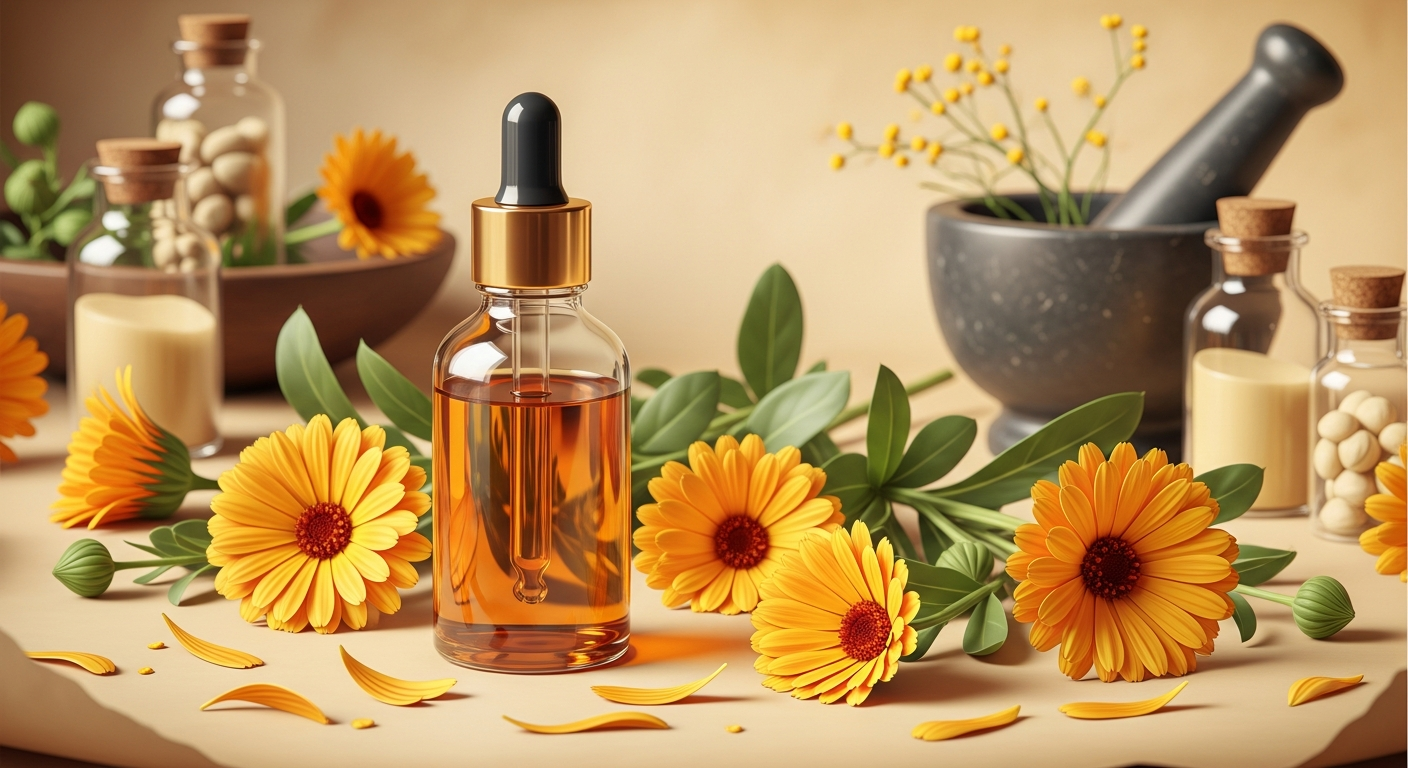
Calendula Oil in Aromatherapy: Blending, Diffusing & Therapeutic Applications
\n\n\n\nThe golden petals of Calendula officinalis have enchanted botanical enthusiasts for centuries, and their aromatic journey into modern aromatherapy continues to captivate practitioners seeking nature's gentle embrace. While calendula oil presents unique considerations in aromatherapy applications, understanding its properties, blending potential, and aromatic characteristics opens a world of sensory possibilities for those drawn to its warm, herbaceous essence.
\n\nThis comprehensive guide explores the multifaceted world of calendula oil in aromatherapy, from foundational blending principles to advanced diffusion techniques. Whether you're a seasoned aromatherapist or beginning your journey with botanical essences, you'll discover how calendula oil's distinctive profile contributes to harmonious aromatic experiences.
\n\nKey Takeaways
\n- \n
- Calendula oil in aromatherapy requires understanding of carrier oil vs. essential oil distinctions \n
- Blending calendula oil with complementary botanicals may enhance aromatic complexity \n
- Traditional aromatherapy practices have incorporated calendula for its warm, earthy fragrance profile \n
- Proper dilution and safety considerations are essential for optimal aromatic experiences \n
- Modern diffusion techniques offer various methods for enjoying calendula's gentle aroma \n
Table of Contents
\n- \n
- Understanding Calendula in Aromatherapy Context \n
- Aromatic Profile and Properties \n
- Blending Fundamentals with Calendula Oil \n
- Diffusion Techniques and Methods \n
- Traditional Aromatherapy Applications \n
- Safety Considerations and Best Practices \n
- Advanced Blending Techniques \n
- Storage and Preservation Methods \n
Understanding Calendula in Aromatherapy Context
\n\nCalendula's role in aromatherapy presents a fascinating study in botanical complexity. Unlike many plants that yield true essential oils through steam distillation, calendula primarily offers its aromatic compounds through oil infusion methods, creating what aromatherapists term a \"carrier oil\" rather than a pure essential oil. This distinction fundamentally shapes how we approach calendula in aromatic applications.
\n\n\n\nThe Nature of Calendula Oil
\n\nCalendula oil typically results from infusing fresh or dried calendula petals in carrier oils such as sunflower, olive, or jojoba oil. This process captures the plant's fat-soluble compounds, including carotenoids that contribute to its golden color and subtle aromatic profile. While some research suggests calendula may contain trace amounts of volatile compounds, the concentration differs significantly from traditional essential oils.
\n\nThis unique characteristic means that calendula oil functions differently in aromatherapy blends. Rather than providing intense, concentrated fragrance notes like lavender or eucalyptus essential oils, calendula contributes gentle, herbaceous undertones that enhance rather than dominate aromatic compositions.
\n\nHistorical Context in Aromatherapy
\n\nTraditional European aromatherapy practices have long incorporated calendula-infused oils for their subtle, warm fragrance profile. Historical texts suggest that aromatherapists valued calendula not for its intensity, but for its ability to harmonize and ground more volatile aromatic compounds. This harmonizing quality has made calendula a sought-after component in complex aromatic blends.
\n\nModern aromatherapy continues this tradition, with practitioners reporting that calendula oil may help create what they describe as \"aromatic bridges\" between disparate fragrance families, allowing for more cohesive and balanced olfactory experiences.
\n\nAromatic Profile and Properties
\n\nUnderstanding calendula's aromatic profile forms the foundation for successful aromatherapy applications. The oil's fragrance characteristics influence how it behaves in blends, its compatibility with other botanicals, and its overall contribution to aromatic experiences.
\n\nFragrance Classification
\n\nCalendula oil typically exhibits what perfumers classify as a \"green-herbaceous\" profile with the following characteristics:
\n\n- \n
- Top notes: Fresh, slightly grassy impressions that may remind some of hay or dried flowers \n
- Heart notes: Warm, honey-like sweetness with subtle spicy undertones \n
- Base notes: Earthy, woody foundation with hints of dried herbs \n
This complex profile makes calendula oil particularly suitable for blends seeking to bridge floral and earthy fragrance families. Its moderate intensity allows it to support both delicate and robust aromatic compositions without overwhelming subtle notes or being lost among stronger ones.
\n\n\n\nVolatile Compound Considerations
\n\nWhile calendula oil contains fewer volatile compounds than traditional essential oils, some research suggests it may include:
\n\n- \n
- Trace amounts of monoterpenes contributing to its fresh qualities \n
- Sesquiterpenes that may provide grounding, earthy notes \n
- Various esters potentially contributing to its gentle, sweet characteristics \n
These compounds, though present in lower concentrations than in essential oils, still contribute to calendula's aromatic complexity and its reported ability to enhance other fragrance components in blends.
\n\nSeasonal and Source Variations
\n\nCalendula's aromatic profile can vary based on several factors:
\n\n| Factor | \nAromatic Impact | \nConsiderations | \n
|---|---|---|
| Harvest timing | \nPeak bloom yields stronger fragrance | \nMorning harvest may capture more volatiles | \n
| Drying method | \nAffects compound preservation | \nGentle drying maintains aromatic complexity | \n
| Carrier oil choice | \nInfluences overall fragrance profile | \nNeutral carriers preserve calendula notes | \n
| Geographic origin | \nSoil and climate affect aromatic compounds | \nMediterranean sources often more aromatic | \n
Blending Fundamentals with Calendula Oil
\n\nCreating successful calendula oil blends requires understanding both the technical aspects of oil compatibility and the artistic principles of fragrance harmony. Calendula's unique position as an infused oil rather than a pure essential oil influences blending approaches and ratio considerations.
\n\nUnderstanding Oil Compatibility
\n\nWhen working with calendula oil in calendula aromatherapy applications, consider these fundamental compatibility principles:
\n\nCarrier Oil Integration: Since calendula oil already contains a carrier oil base, blending with pure essential oils requires careful attention to final dilution ratios. Traditional aromatherapy guidelines suggest maintaining overall essential oil concentrations below 3-5% for topical applications, but calendula oil's pre-diluted nature affects these calculations.
\n\nFragrance Family Harmony: Calendula's herbaceous-floral profile creates natural affinity with several fragrance families. Understanding these relationships helps create harmonious blends that showcase rather than mask calendula's subtle characteristics.
\n\n\n\nComplementary Botanical Partners
\n\nExperience suggests certain botanicals may enhance calendula's aromatic qualities:
\n\nFloral Companions:
\n- \n
- Lavender: May complement calendula's gentle nature while adding relaxing qualities \n
- Roman Chamomile: Traditional pairing that some report creates soothing aromatic experiences \n
- Rose Geranium: May enhance calendula's sweet undertones \n
Citrus Brighteners:
\n- \n
- Sweet Orange: May lift calendula's earthier notes with sunny warmth \n
- Bergamot: Traditional combination that aromatherapists report balances herbaceous and citrus elements \n
- Lemon: May provide fresh contrast to calendula's deeper notes \n
Grounding Elements:
\n- \n
- Frankincense: May enhance calendula's meditative qualities \n
- Sandalwood: Traditional pairing that some find creates rich, complex base notes \n
- Cedarwood: May complement calendula's earthy characteristics \n
Basic Blending Ratios
\n\nFor those new to working with calendula oil blends, these foundational ratios provide starting points for experimentation:
\n\n\n\n\nBeginner's Blend Formula:
\n
\n- 70% calendula oil (base)
\n- 20% complementary carrier oil (if additional dilution desired)
\n- 10% essential oil blend (maximum 2-3 different oils)
This ratio ensures calendula remains prominent while allowing room for aromatic enhancement. As comfort with blending grows, these ratios can be adjusted based on desired intensity and application method.
\n\nFor comprehensive guidance on oil blending principles beyond calendula-specific applications, refer to our detailed essential oil blending guide.
\n\nDiffusion Techniques and Methods
\n\nDiffusing calendula essential oil blends presents unique considerations due to calendula oil's carrier oil content. Unlike pure essential oils that readily disperse through ultrasonic or nebulizing diffusers, calendula oil requires adapted techniques to achieve effective aromatic distribution.
\n\nTraditional Diffusion Methods
\n\nHeat-Based Diffusion: Traditional oil burners or candle-powered diffusers may work well with calendula oil, as gentle heat helps volatilize the available aromatic compounds without requiring the fine mist production needed for pure essential oils. This method may be particularly suitable for calendula's subtle fragrance profile.
\n\nPassive Diffusion Techniques:
\n- \n
- Reed Diffusers: Calendula oil's viscosity makes it suitable for reed diffusion, though expect gentler fragrance throw compared to essential oil-based blends \n
- Aromatic Sachets: Calendula-infused fabrics or potpourri may provide long-lasting, subtle fragrance release \n
- Room Sprays: Calendula oil can be incorporated into alcohol-based room sprays for gentle aromatic enhancement \n
Modern Ultrasonic Adaptation
\n\nWhile pure calendula oil may not be ideal for ultrasonic diffusers due to its carrier oil content, several adaptation techniques allow for effective use:
\n\nDilution Method: Some aromatherapy practitioners report success with heavily diluting calendula oil (1-2 drops in 10ml of water) for ultrasonic diffusers, though this significantly reduces aromatic intensity.
\n\nEssential Oil Enhancement: Blending calendula oil with compatible essential oils may create diffuser-appropriate consistency while maintaining calendula's aromatic contribution. A typical ratio might include 2 parts calendula oil to 1 part essential oil blend.
\n\nCarrier-Free Alternatives: For those seeking calendula aromatherapy through ultrasonic diffusion, seeking calendula absolute or CO2 extracts (though rare and expensive) may provide carrier-free options more suitable for these devices.
\n\nRoom-Specific Applications
\n\nDifferent spaces may benefit from tailored calendula diffusion approaches:
\n\n| Space | \nRecommended Method | \nSuggested Blends | \nDuration Guidelines | \n
|---|---|---|---|
| Bedroom | \nPassive reed diffusion | \nCalendula + Lavender | \nContinuous, low intensity | \n
| Living Room | \nOil burner or warmer | \nCalendula + Sweet Orange | \n2-3 hours maximum | \n
| Home Office | \nAromatic sachets | \nCalendula + Rosemary | \nRefresh weekly | \n
| Bathroom | \nRoom spray | \nCalendula + Eucalyptus | \nAs needed | \n
Traditional Aromatherapy Applications
\n\nThroughout aromatherapy's rich history, calendula has held a special place in traditional practices. Understanding these time-honored applications provides valuable context for modern use while respecting the botanical wisdom passed down through generations of practitioners.
\n\nHistorical European Traditions
\n\nEuropean aromatherapy traditions, particularly those from Mediterranean regions where calendula grows abundantly, have long incorporated this golden flower into aromatic practices. Historical texts suggest that traditional practitioners valued calendula not for dramatic aromatic impact, but for its ability to create what they described as \"harmonious foundations\" in complex blends.
\n\nSeasonal Celebrations: Traditional calendula aromatherapy often aligned with seasonal cycles. Some historical accounts describe the use of calendula-infused oils during harvest festivals, where the flower's warm, earthy fragrance was thought to embody the abundance of late summer and early autumn.
\n\nMeditative Practices: Monastic traditions occasionally incorporated calendula's gentle aroma into contemplative practices. The subtle, non-overwhelming nature of calendula's fragrance made it suitable for extended aromatic exposure during meditation or prayer.
\n\n\n\nTraditional Blending Wisdom
\n\nClassical aromatherapy approaches to calendula blending emphasized balance and subtlety. Traditional practitioners often followed these principles:
\n\nThe \"Golden Ratio\" Approach: Some traditional systems suggested using calendula as approximately one-third of any blend, allowing its harmonizing properties to integrate other components without dominating the overall fragrance experience.
\n\nComplementary Seasonal Pairing: Traditional practice often paired calendula with botanicals from similar growing seasons and geographic regions, believing this created more harmonious aromatic relationships. Common traditional combinations included:
\n\n- \n
- Calendula with Mediterranean herbs like rosemary and thyme \n
- Autumn blends featuring calendula with apple and warming spices \n
- Spring combinations of calendula with early blooming flowers \n
Modern Interpretation of Traditional Methods
\n\nContemporary aromatherapy continues to draw from traditional calendula applications while adapting them for modern lifestyles and preferences. This evolution respects historical wisdom while embracing current understanding of aromatic compounds and safety considerations.
\n\nAdapted Meditation Blends: Modern practitioners may create calendula-based blends for mindfulness practices, drawing on traditional associations with contemplation while incorporating contemporary favorites like sandalwood or frankincense.
\n\nSeasonal Wellness Support: Traditional seasonal applications have evolved into modern approaches that may support general well-being during transitional periods, though practitioners are careful to frame such uses as aromatic experiences rather than health interventions.
\n\nFor broader applications beyond aromatherapy, explore our comprehensive guide to calendula oil uses in various wellness contexts.
\n\nSafety Considerations and Best Practices
\n\nSafe practices form the cornerstone of responsible aromatherapy, and calendula oil applications require specific safety awareness. While calendula is generally considered gentle, understanding proper precautions ensures positive experiences and prevents adverse reactions.
\n\nDilution Guidelines
\n\nProper dilution represents the most critical safety consideration when using calendula oil in aromatherapy applications:
\n\nPre-Diluted Nature: Remember that most calendula oils are already diluted in carrier oils. However, when blending with essential oils, additional dilution considerations apply:
\n\n- \n
- For topical applications: Maximum 2-3% total essential oil content in final blend \n
- For diffusion: Follow device-specific guidelines, typically 3-5 drops per 100ml water \n
- For bath applications: Always pre-dilute in carrier oil before adding to water \n
Patch Testing Protocol: Even with generally gentle botanicals like calendula, individual sensitivities can occur. Always perform patch tests:
\n\n- \n
- Apply small amount of diluted blend to inner forearm \n
- Cover with bandage and leave for 24 hours \n
- Check for redness, irritation, or other reactions \n
- Discontinue use if any adverse reactions occur \n
Contraindications and Special Populations
\n\nCertain groups require additional precautions when using calendula oil in aromatherapy:
\n\nAllergy Considerations: Individuals with known sensitivities to plants in the Asteraceae family (including ragweed, chrysanthemums, marigolds, and daisies) should exercise particular caution with calendula. Cross-reactivity may occur, though calendula is generally considered less allergenic than many family relatives.
\n\nPregnancy and Nursing: While calendula is traditionally considered gentle, pregnant and nursing women should consult qualified healthcare providers before using any aromatherapy products. Some traditional sources suggest avoiding certain applications during early pregnancy, though modern research on calendula aromatherapy during pregnancy remains limited.
\n\nChildren and Infants: Pediatric aromatherapy requires significantly reduced concentrations and careful supervision:
\n- \n
- Infants under 3 months: Avoid direct aromatherapy applications \n
- Children 3-24 months: Maximum 0.25% dilution if used at all \n
- Children 2-6 years: Maximum 1% dilution with adult supervision \n
- Always consult pediatric healthcare providers before use \n
Quality and Source Considerations
\n\nSafety depends significantly on oil quality and sourcing:
\n\nSource Verification: Choose calendula oils from reputable suppliers who provide:
\n- \n
- Clear information about extraction methods \n
- Details about carrier oil used in infusions \n
- Batch testing information when available \n
- Proper storage and handling practices \n
Storage Safety: Proper storage maintains oil quality and prevents contamination:
\n- \n
- Store in dark glass containers away from light and heat \n
- Keep containers tightly sealed to prevent oxidation \n
- Label all blends with ingredients and creation dates \n
- Discard oils showing signs of rancidity or contamination \n
Interaction Awareness: While calendula oil interactions are rarely reported, always inform healthcare providers about aromatherapy use, especially if taking medications or managing health conditions. Essential oils can potentially interact with medications or affect sensitive individuals.
\n\nAdvanced Blending Techniques
\n\nAs comfort with basic calendula aromatherapy grows, advanced techniques open new possibilities for complex, sophisticated aromatic experiences. These methods build upon foundational knowledge while introducing nuanced approaches to fragrance development and aromatic layering.
\n\nAromatic Layering Principles
\n\nAdvanced calendula blending involves understanding how different aromatic compounds interact over time. Unlike simple mixing, layering creates evolving fragrance experiences that change throughout diffusion or wear.
\n\nTemporal Fragrance Development:
\n- \n
- Opening Notes (0-15 minutes): Light, volatile compounds provide initial impression \n
- Heart Development (15-60 minutes): Core fragrance character emerges as initial volatiles dissipate \n
- Base Evolution (1+ hours): Deeper, more persistent compounds become prominent \n
Calendula's moderate volatility places it primarily in the heart and base categories, making it excellent for creating aromatic bridges between faster-dissipating top notes and long-lasting base elements.
\n\n\n\nComplex Blend Formulation
\n\nAdvanced practitioners often work with what they term \"aromatic families\" – groups of botanicals that share complementary characteristics:
\n\nThe \"Garden Harmony\" Family:
\n- \n
- Base: Calendula oil (40%) \n
- Heart: Rose geranium (25%) \n
- Bridge: Roman chamomile (20%) \n
- Accent: Sweet orange (15%) \n
This blend demonstrates advanced layering where calendula provides the foundational warmth, rose geranium adds floral sophistication, chamomile bridges herbaceous and floral elements, and sweet orange lifts the overall composition.
\n\nThe \"Meditative Earth\" Family:
\n- \n
- Foundation: Calendula oil (35%) \n
- Grounding: Frankincense (30%) \n
- Warmth: Sandalwood (20%) \n
- Brightening: Bergamot (15%) \n
This composition showcases calendula's ability to harmonize resinous and woody elements while maintaining aromatic accessibility.
\n\nSeasonal Adaptation Techniques
\n\nAdvanced aromatherapy practice often involves adapting blends for seasonal variations, understanding how environmental factors affect both oil behavior and personal aromatic preferences:
\n\n| Season | \nCalendula Modifications | \nComplementary Additions | \nDiffusion Adjustments | \n
|---|---|---|---|
| Spring | \nIncrease calendula ratio for grounding | \nLight florals, green notes | \nShorter diffusion periods | \n
| Summer | \nReduce concentration due to heat | \nCitrus, mint, eucalyptus | \nCool diffusion methods preferred | \n
| Autumn | \nPeak calendula expression | \nSpices, woods, resins | \nWarming diffusion techniques | \n
| Winter | \nLayer with warming oils | \nConifers, warming spices | \nExtended, gentle diffusion | \n
Therapeutic Aromatherapy Integration
\n\nAdvanced practitioners often integrate calendula aromatherapy with other wellness practices, understanding that aromatic experiences may complement various lifestyle approaches:
\n\nMindfulness Enhancement: Some practitioners report that calendula's gentle, non-intrusive fragrance makes it particularly suitable for meditation support. The oil's subtle nature allows for extended exposure without becoming overwhelming or distracting during contemplative practices.
\n\nSleep Environment Optimization: Advanced sleep aromatherapy might incorporate calendula as part of multi-layered nighttime routines. Its gentle nature makes it suitable for bedroom use, while its traditional associations with evening and rest align with sleep preparation practices.
\n\nFor applications that extend beyond pure aromatherapy into topical wellness support, our guide to calendula oil massage explores these broader applications.
\n\nStorage and Preservation Methods
\n\nProper storage and preservation techniques ensure calendula oil maintains its aromatic integrity and safety profile over time. Understanding how environmental factors affect oil quality enables aromatherapy enthusiasts to maximize their investment in quality botanicals.
\n\nEnvironmental Factors Affecting Quality
\n\nSeveral environmental conditions significantly impact calendula oil stability:
\n\nLight Exposure: Ultraviolet light accelerates oil degradation, breaking down aromatic compounds and potentially creating off-odors. Calendula oil, with its natural carotenoid content, is particularly susceptible to light damage. The golden color that makes calendula oil visually appealing can fade with light exposure, often indicating aromatic compound degradation.
\n\nTemperature Fluctuations: Extreme temperatures and temperature variations stress oil molecular structures. While refrigeration isn't typically necessary for calendula oil, storage in consistently cool environments (60-70°F/15-21°C) helps preserve aromatic integrity.
\n\nOxygen Exposure: Oxidation represents one of the primary threats to oil quality. When calendula oil contacts air, oxidative processes begin that can create rancid odors and potentially irritating compounds. This is particularly important for calendula oil due to its carrier oil content, which is generally more susceptible to oxidation than pure essential oils.
\n\n\n\nOptimal Storage Conditions
\n\nContainer Selection: Dark glass containers provide optimal protection for calendula oil:
\n- \n
- Amber or cobalt blue glass blocks harmful light wavelengths \n
- Glass doesn't react with oil components unlike some plastics \n
- Proper glass bottles minimize air exchange when sealed \n
- Size containers appropriately – smaller bottles for frequently used oils reduce air exposure \n
Sealing Techniques: Proper sealing prevents oxidation and contamination:
\n- \n
- Use containers with tight-fitting caps that create airtight seals \n
- Consider using nitrogen flushing for long-term storage of valuable oils \n
- Replace caps immediately after use to minimize air exposure \n
- Check seals periodically and replace damaged closures \n
Location Considerations: Ideal storage locations provide stable conditions:
\n- \n
- Cool, consistent temperatures away from heating sources \n
- Dark environments away from windows and bright lights \n
- Low humidity areas to prevent condensation issues \