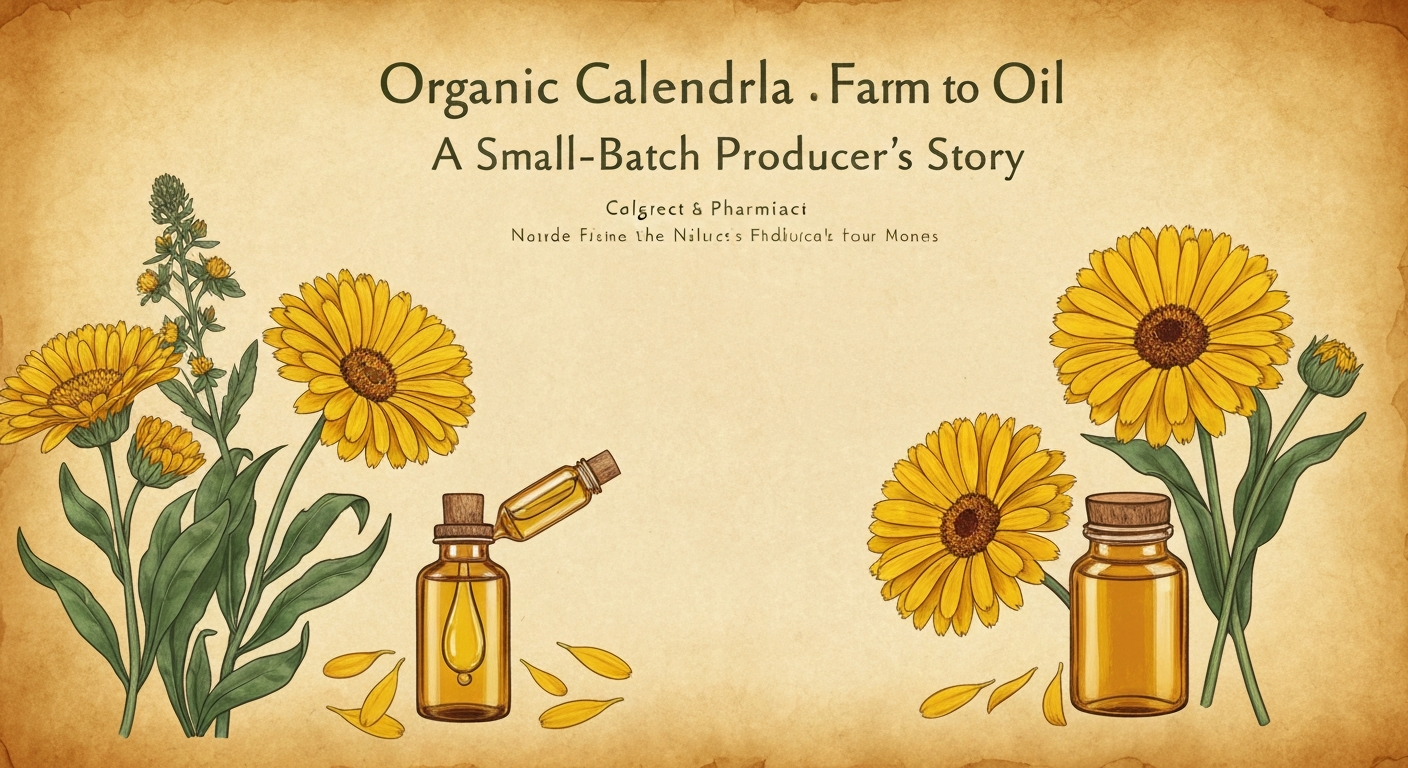
Organic Calendula Farm to Oil: A Small-Batch Producer's Story
In the rolling hills of Vermont, where morning mist settles over golden fields, Sarah Martinez has spent the last eight years perfecting something remarkable: a completely integrated approach to calendula oil production that honors both traditional farming wisdom and modern quality standards. Her story offers valuable insights into what it truly takes to create premium organic calendula oil from seed to bottle.
This case study follows Moonrise Farm's evolution from a small hobby garden to a respected small-batch producer, examining the challenges, innovations, and lessons learned along the way. For anyone curious about the journey behind artisan botanical oils, Sarah's experience illuminates the dedication required to maintain quality at every step of production.
The Challenge: Creating Truly Sustainable Production
When Sarah first began growing calendula in 2016, she faced a common dilemma among small-scale producers: how to maintain consistent quality while scaling production sustainably. The calendula oil market had grown increasingly competitive, with many producers cutting corners on sourcing or extraction methods to reduce costs.
"I kept seeing beautiful calendula oils at farmers markets, but when I'd ask about the production process, the answers were vague," Sarah recalls. "I realized there was a real need for transparency in how these oils are made, from the soil preparation all the way to the final product."
The challenges she identified were multifaceted:
- Seasonal variability: Calendula flowers don't bloom uniformly, making consistent harvesting difficult
- Weather dependency: Vermont's unpredictable weather patterns could devastate entire crops
- Quality maintenance: Ensuring potent flower material while scaling production
- Economic viability: Balancing premium quality with sustainable pricing
- Regulatory compliance: Navigating organic certification and production standards
Most significantly, Sarah wanted to create a production model that could serve as a template for other small-scale farmers interested in botanical oil production. "I believed that if we could document our process thoroughly, it might help other growers avoid some of the mistakes we made early on," she explains.
The Approach: Integrated Farm-to-Oil Production
Phase 1: Soil and Seed Selection (Years 1-2)
Sarah's approach began with the foundation: soil health and seed selection. Rather than purchasing calendula starts from commercial nurseries, she chose to work with heritage seed varieties specifically selected for oil production.
"We tested three different calendula varieties over two seasons," Sarah notes. "Calendula officinalis 'Resina' consistently produced the most resinous flowers, which translated to better oil yield during extraction."
The soil preparation involved a two-year transition to certified organic status, during which Sarah implemented:
- Cover cropping with nitrogen-fixing legumes during off-seasons
- Composted manure incorporation each spring
- Regular soil testing to monitor nutrient levels and pH
- Crop rotation with beneficial companion plants
This methodical approach to soil health became the cornerstone of consistent flower quality. "Healthy soil produces resilient plants, and resilient plants produce the kind of flowers that make exceptional oil," Sarah observes.
Phase 2: Cultivation and Harvest Optimization (Years 3-4)
With soil health established, Sarah focused on optimizing cultivation practices for oil production specifically. This meant adjusting traditional calendula growing methods to maximize the compounds most valuable for oil-making.
Key innovations included:
- Succession planting: Staggered seeding every two weeks from March through July to ensure continuous harvest
- Selective harvesting: Picking flowers at peak bloom in early morning when essential oil compounds are most concentrated
- Immediate processing: Processing harvested flowers within four hours to preserve quality
- Weather tracking: Using local weather data to optimize harvest timing
"We learned that the timing of harvest makes an enormous difference in the final product," Sarah explains. "Flowers picked in the late afternoon after a hot day just don't have the same potency as those harvested in the cool morning hours."
Phase 3: Extraction Method Development (Years 4-6)
The calendula oil extraction process became Sarah's most intensive area of experimentation. After researching various methods, she settled on a dual approach that combined traditional solar infusion with modern low-heat extraction techniques.
The process Sarah developed involves:
- Fresh flower preparation: Flowers are gently cleaned and allowed to wilt for 12 hours to reduce moisture content
- Initial infusion: Flowers are combined with organic sunflower oil in glass vessels
- Solar extraction: Vessels are placed in custom-built solar chambers for 4-6 weeks
- Secondary heating: Low-temperature heating (under 100°F) for final extraction
- Straining and settling: Multiple filtration stages to ensure clarity
- Quality testing: Color, scent, and consistency evaluation
"The solar infusion method takes patience, but it produces an oil with incredible color and what I believe is superior quality," Sarah notes. "We're not rushing the process with high heat that might compromise the delicate compounds we're trying to preserve."
Implementation Challenges and Solutions
Weather-Related Setbacks
Vermont's unpredictable weather presented ongoing challenges. In 2019, an unseasonably wet summer led to fungal issues that affected nearly 30% of the crop. Sarah's response was to implement covered growing areas and improve drainage systems.
"That difficult season taught us the importance of having contingency plans," she reflects. "Now we grow in multiple locations across the property and have greenhouse space as backup."
Scaling Production
As demand grew, maintaining quality while increasing volume became increasingly complex. Sarah's solution was to focus on efficiency improvements rather than simply expanding acreage.
Improvements included:
- Custom-designed solar extraction chambers that doubled processing capacity
- Streamlined harvesting tools that reduced labor time by 40%
- Inventory management systems to track batches through production
- Quality control checklists for every production stage
Outcomes and Observations
Production Metrics
After eight years of operation, Moonrise Farm has achieved remarkable consistency in production:
| Year | Flower Yield (lbs) | Oil Production (gallons) | Quality Score* |
|---|---|---|---|
| 2016 | 45 | 2.1 | 7.2 |
| 2018 | 178 | 8.4 | 8.1 |
| 2020 | 245 | 11.7 | 8.6 |
| 2022 | 312 | 14.9 | 9.1 |
| 2024 | 385 | 18.3 | 9.3 |
*Quality score based on color consistency, scent profile, and viscosity (1-10 scale)
Customer Feedback Trends
Customer response has been overwhelmingly positive, with several recurring themes in feedback:
"The difference in color and scent compared to other calendula oils is remarkable. You can tell this is made with care." - Local aromatherapist
"Knowing exactly where and how the calendula is grown gives me confidence in the product quality." - Soap maker and regular customer
Return customers now comprise 78% of sales, suggesting strong satisfaction with product consistency. Many customers specifically cite the transparency of production methods as a key factor in their purchasing decisions.
Environmental Impact
Sarah's integrated approach has yielded unexpected environmental benefits:
- Soil organic matter has increased by 2.3% over eight years
- The calendula fields support diverse beneficial insect populations
- Solar-powered extraction reduces energy consumption by an estimated 85% compared to heated methods
- Compost production from plant waste has eliminated the need for external soil amendments
"We've created what feels like a closed-loop system," Sarah observes. "The farm feeds the production process, and the production process feeds back into farm health."
Key Learnings and Insights
Quality Over Quantity
Perhaps the most significant learning has been that focusing on quality metrics rather than volume metrics leads to better long-term success. "We could probably triple our production if we were willing to compromise on our standards," Sarah explains, "but our customers come to us specifically because we don't take those shortcuts."
Documentation Is Essential
Meticulous record-keeping has proven invaluable for maintaining consistency and troubleshooting problems. Sarah maintains detailed logs of:
- Weather conditions during growing and harvesting
- Soil test results and amendment applications
- Harvest dates, times, and quantities
- Extraction batch details and timing
- Customer feedback and quality assessments
"Looking back through our records, we can identify exactly what conditions produce our best oils," she notes. "That data has been worth its weight in gold."
Community Connections Matter
Building relationships with other local growers, herbalists, and customers has provided both practical support and valuable feedback. Sarah regularly participates in local farming networks and has mentored three other small-scale producers interested in botanical oil production.
"The isolation of farming can be challenging, but being part of a community of people who understand what you're trying to achieve makes all the difference," she reflects.
Sustainability and Future Directions
Economic Sustainability
After eight years, Moonrise Farm has achieved financial sustainability while maintaining premium quality standards. Key factors in this success include:
- Direct-to-consumer sales that eliminate middleman markups
- Diversified product line including dried calendula flowers and value-added products
- Educational workshops that provide additional revenue streams
- Seasonal CSA shares that provide predictable income
Knowledge Sharing Initiatives
Sarah has begun documenting her production methods in detail, with plans to publish a comprehensive guide for small-scale calendula oil production. "If our model can help other farmers create sustainable botanical oil operations, that feels like a meaningful contribution," she explains.
She also hosts annual farm tours and workshops, sharing practical techniques with aspiring producers. These educational initiatives have become an important part of the farm's mission.
Innovation Continues
Current research projects include experimenting with complementary herbs in polyculture systems and developing small-scale equipment designs that other producers could replicate. "There's always room for improvement," Sarah notes. "That's what keeps this work interesting after all these years."
Implications for Small-Scale Production
Sarah's experience at Moonrise Farm offers several insights for anyone considering small-scale calendula oil production:
- Start small and scale thoughtfully: Rushing expansion often compromises quality
- Invest in soil health first: Everything else builds from this foundation
- Document everything: Records become invaluable for consistency and improvement
- Focus on your local market initially: Building regional relationships provides stability
- Don't compromise on core values: Quality-focused customers will pay for authenticity
- Plan for weather variability: Climate resilience requires redundant systems
"If I could go back and give advice to myself eight years ago, it would be to trust the process and not rush the timeline," Sarah reflects. "Good calendula oil, like good farming, can't be hurried."
Conclusion: A Model for Artisan Production
The story of Moonrise Farm demonstrates that small-scale, quality-focused calendula oil production is not only viable but can serve as a model for sustainable agricultural practices. Sarah's integrated approach—from soil health through final product—shows how attention to detail at every stage creates cumulative quality improvements that customers recognize and value.
Perhaps most importantly, her experience illustrates that transparency and education can be powerful differentiators in an increasingly crowded marketplace. By sharing her methods openly and building genuine relationships with customers, Sarah has created something more than just a successful business—she's built a model that other producers can learn from and adapt to their own circumstances.
As consumer interest in artisan botanical products continues to grow, stories like Sarah's provide both inspiration and practical guidance for those considering similar ventures. The path from hobby gardener to respected producer is challenging but, as Moonrise Farm demonstrates, entirely achievable with patience, dedication, and a commitment to quality that never wavers.
For those interested in exploring calendula oil production, whether as consumers or potential producers, Sarah's journey reminds us that the best products come from people who care deeply about every step of the process—from the health of the soil to the satisfaction of the final customer.